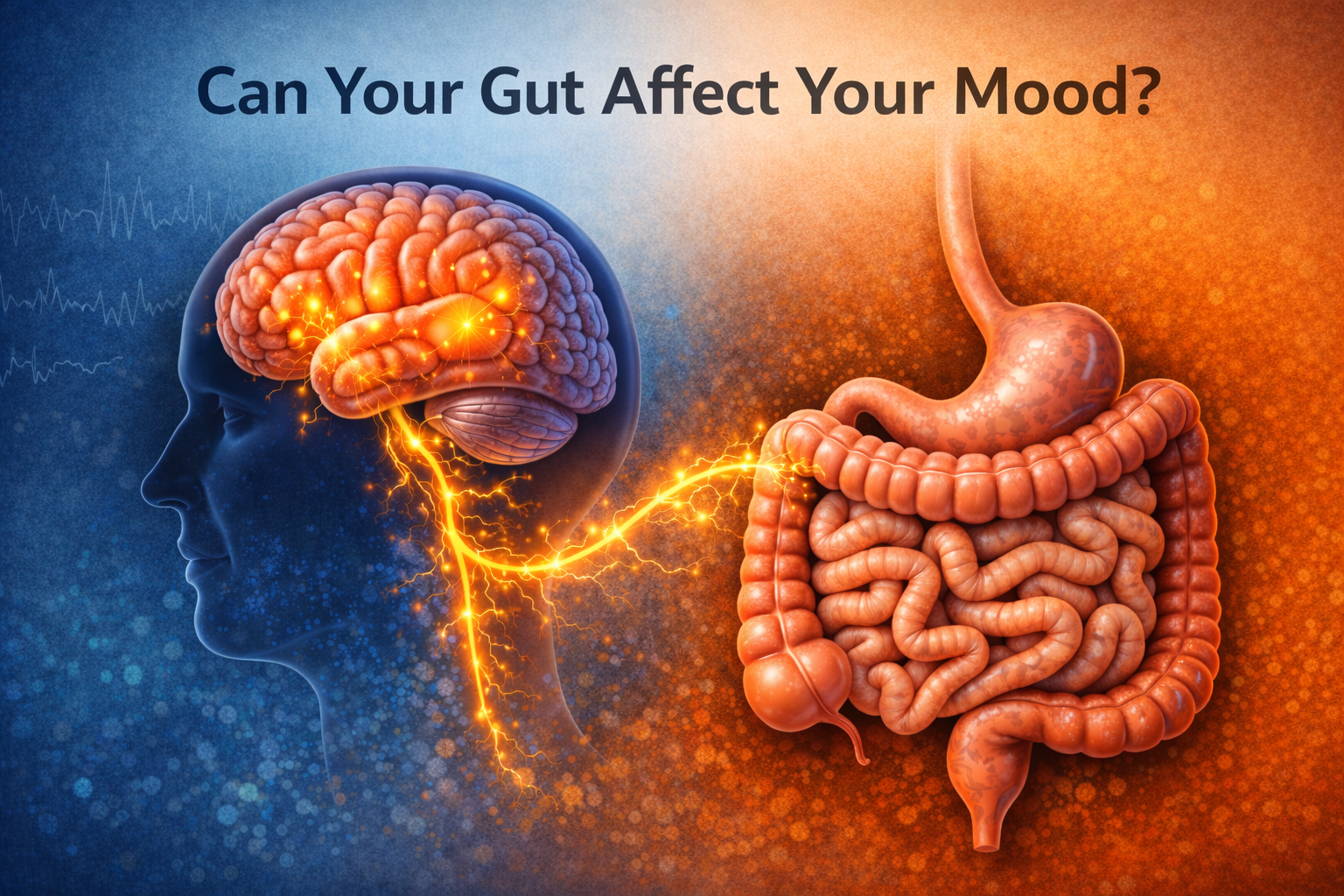
Imagine you’re anxious, low, or mentally foggy—and someone tells you the problem might be in your gut. It’s a seductive idea: change your microbes, change your mind. Over the last decade, this gut–brain story has exploded across podcasts, supplement shelves, and headlines.
But what does the research actually show?
Here’s the most honest version: the gut and brain do communicate, and the microbiome seems to influence that conversation. Yet most strong causal evidence comes from animal studies, while human evidence is real but limited and mixed. The science is promising—but it’s not a shortcut, and it’s not a replacement for mental healthcare.¹–⁵
Why This Topic Matters
Depression and anxiety are among the most common mental health conditions worldwide. At the same time, modern diets have shifted toward ultra-processed foods, refined carbohydrates, and lower fiber intake—patterns linked to worse cardiometabolic health and, increasingly, worse mental wellbeing.
A BMJ article argues that improving diet could support mental health at a population level, but stresses something crucial: the relationship is complicated by reverse causality. Mood affects diet, and diet may affect mood.¹
So the question isn’t “Does diet or the microbiome cause depression?” It’s more practical—and more scientific:
Under what conditions might food and microbes meaningfully influence mood—and how strong is the evidence?
What Researchers Investigated
Across the sources we reviewed, this story comes from three layers of evidence:
- Mechanistic biology (how gut signals could reach the brain)
- Animal experiments (where microbes can be manipulated directly)
- Human data (observational studies and clinical trials)
A 2019 clinical review study lays out the main mechanisms of the gut–brain axis and the clinical implications—while repeatedly emphasizing uncertainty.²
Two major 2015 features—one in PNAS article and one in Scientific American article—capture how the field gained momentum, and why many researchers still warn against overinterpretation.³⁴
An editorial article pushes the idea toward “psychobiotics” (microbe-based mental health interventions), but it also illustrates where enthusiasm can run ahead of replicable, actionable evidence.⁵
What They Found
1) The gut–brain axis is real—and it runs both ways
Researchers describe multiple overlapping pathways:
- Neural signaling, especially through the vagus nerve
- Immune signaling, including inflammatory cytokines
- Hormonal signaling, tied to stress physiology (HPA axis)
- Microbial metabolites, such as short-chain fatty acids and tryptophan-related compounds
The key theme is bidirectionality: stress and emotions can change gut function and the microbial ecosystem, while microbial activity can influence signaling that reaches the brain.²
2) Animal studies show causality—but they may not map cleanly onto humans
A big reason the field gained traction is that in rodents, researchers can do experiments that aren’t possible in humans:
- Raise animals germ-free (no microbes at all)
- Use antibiotics to disrupt microbes
- Perform fecal transplants to shift microbial communities
These approaches repeatedly show that microbial manipulation can change stress responses, anxiety-like behaviors, and aspects of brain chemistry.³⁴
But here’s the catch the best scientists emphasize: germ-free mice are not “normal humans without probiotics.” They develop differently—immune system, brain development, and behavior. That makes them powerful for asking if microbes matter, but less reliable for telling us what to do clinically.³⁴
3) Timing may matter: early life looks like a sensitive window
One of the most consistent ideas across sources is that microbiome effects may be strongest during early life, when neural circuits are being established. Animal work suggests that introducing microbes early can reverse some stress-related abnormalities, while introducing them later often cannot.³
This doesn’t prove early-life probiotics prevent mental illness—but it supports a broader developmental principle: biology is often more malleable earlier than later.
4) Diet is a more human-grounded lever than supplements
If the microbiome conversation is one lane, diet is the highway.
The BMJ article highlights evidence that:
- Mediterranean-style dietary patterns are associated with a lower risk of depression in observational studies (but causality is tricky).¹
- High glycaemic load diets (refined carbs/sugars) are associated with more depressive symptoms, and controlled studies suggest they can worsen mood in the short term—possibly through glucose swings and stress-hormone responses.¹
- Diet may influence mood partly through inflammation: Western-style diets tend to be pro-inflammatory, while Mediterranean patterns tend to reduce inflammatory markers.¹
This matters because inflammation seems to play a role in depression for some people—but not everyone. The BMJ authors emphasize the likely existence of an “inflammatory phenotype” (a subgroup more likely to benefit from anti-inflammatory approaches, including diet).¹
5) Probiotics and “psychobiotics”: intriguing, but not ready for big claims
The Deans editorial article paints a bold future: psychobiotics as low-side-effect tools for mental illness.⁵ But even across the broader set of sources, the caution is clear:
- Human probiotic trials are often small, short, and heterogeneous
- Effects may be strain-specific, not “probiotics in general”
- Expectations/placebo effects can influence mood outcomes
- Commercial products aren’t standardized like medications
The BMJ article acknowledges promising signals (including altered brain responses to emotional tasks after probiotic consumption) while emphasizing that no specific microbe has been causally tied to complex human emotions.¹
What This Likely Means
Zoomed out, a careful interpretation looks like this:
- Diet quality is a plausible, modifiable contributor to mental wellbeing, especially through glycaemic stability and inflammation.¹
- The microbiome may be one mediator of diet’s effects—but not the only one.¹²
- Microbiome manipulation can change behavior in animals, proving the system can influence the brain.³⁴
- In humans, the microbiome is best viewed as a modulator—one factor among many—rather than a master switch for mood.¹²
What This Does Not Prove
To stay scientifically honest, the evidence does not justify:
- That depression or anxiety are primarily “gut diseases”
- That probiotics reliably treat clinical depression/anxiety
- That microbiome tests can diagnose psychiatric disorders
- That changing one microbe will “fix” mental health
- That diet replaces therapy, medication, or comprehensive care
Even supportive experts warn this field could be oversold unless mechanisms and causality are demonstrated clearly in humans.³
Simple Takeaway for Readers
If you want the most practical interpretation of today’s evidence:
- Start with dietary patterns, not miracle strains. A Mediterranean-style pattern has the best overall support for both physical and mental health outcomes.¹
- Be skeptical of microbiome hype. The gut–brain axis is real, but “microbiome hacking” is ahead of clinical evidence.¹–³
- If probiotics help, it’s likely specific and modest, and depends on strain, person, and context.¹⁵
Better nutrition supports mental health. It doesn’t determine it.
Strength of Evidence
Moderate overall, with a split:
- Strong for biological plausibility and animal causality
- Moderate for diet-pattern associations and some intervention benefits in certain groups
- Weak-to-moderate for probiotics/microbiome-targeted mental health treatments in humans
References
- Firth J, Gangwisch JE, Borisini A, Wootton RE, Mayer EA. Food and mood: how do diet and nutrition affect mental wellbeing?. BMJ. 2020;369:m2382. Published 2020 Jun 29. doi:10.1136/bmj.m2382
- Osadchiy V, Martin CR, Mayer EA. The Gut-Brain Axis and the Microbiome: Mechanisms and Clinical Implications. Clin Gastroenterol Hepatol. 2019;17(2):322-332. doi:10.1016/j.cgh.2018.10.002
- Shen HH. Microbes on the mind: Could the gut microbiome have a critical role in brain and behavior? Proc Natl Acad Sci U S A. 2015;112(30):9143-9145. doi:10.1073/pnas.1509590112
- Schmidt C, Schnorr SL. Thinking From the Gut. Scientific American. 2015;312(3):S13–S16.
- Deans E. Microbiome and mental health in the modern environment. J Physiol Anthropol. 2017;36:1. doi:10.1186/s40101-016-0101-y